

ENTERPRISE KNOWLEDGEPRINTS™
Architect Enterprise Knowledge
Enterprise KnowledgePrints™ provides the architectural framework and capability programs used to design Enterprise Knowledge Models™ — durable structural blueprints that align data platforms, analytics systems, and AI knowledge graphs.
The Enterprise Knowledge Gap
Most organizations generate data.
Few design enterprise knowledge.
Modern enterprises invest heavily in data platforms, analytics ecosystems, ERP transformations, and AI initiatives.
But a growing trend has emerged:
Organizations are being guided to extract and infer business meaning from existing data sources.
Systems are mined.
Schemas are analyzed.
Pipelines are reverse-engineered.
But this approach works backwards.
It assumes that enterprise meaning already exists inside fragmented systems —
when in reality, those systems were never designed to represent consistent business meaning in the first place.
The Result
Conflicting definitions of the same business concept
No consistent enterprise identity model
Integration logic embedded in pipelines instead of design
AI built on inferred, unstable semantics
The Root Problem
Enterprise knowledge is being discovered after the fact,
instead of being designed intentionally before implementation begins.
The Enterprise KnowledgePrints™ Approach
Enterprise Knowledge Architecture™ reverses this pattern.
Instead of mining meaning from systems:
It defines enterprise meaning top-down — from the business.
Business concepts are defined first
Identity and relationships are structured intentionally
Conceptual and Logical Knowledge Models establish the enterprise blueprint
Physical and Semantic models are then derived consistently
The Outcome
When enterprise knowledge is designed intentionally:
Business definitions remain consistent across systems
Integrations align to enterprise meaning — not vendor schemas
Domain expansion becomes predictable and controlled
Analytics and AI operate on a shared semantic foundation
The Shift
Instead of reacting to complexity,
organizations begin designing enterprise knowledge intentionally.
Create the blueprint first. Then build the systems.
This is exactly what the Enterprise KnowledgePrints™ Framework enables.
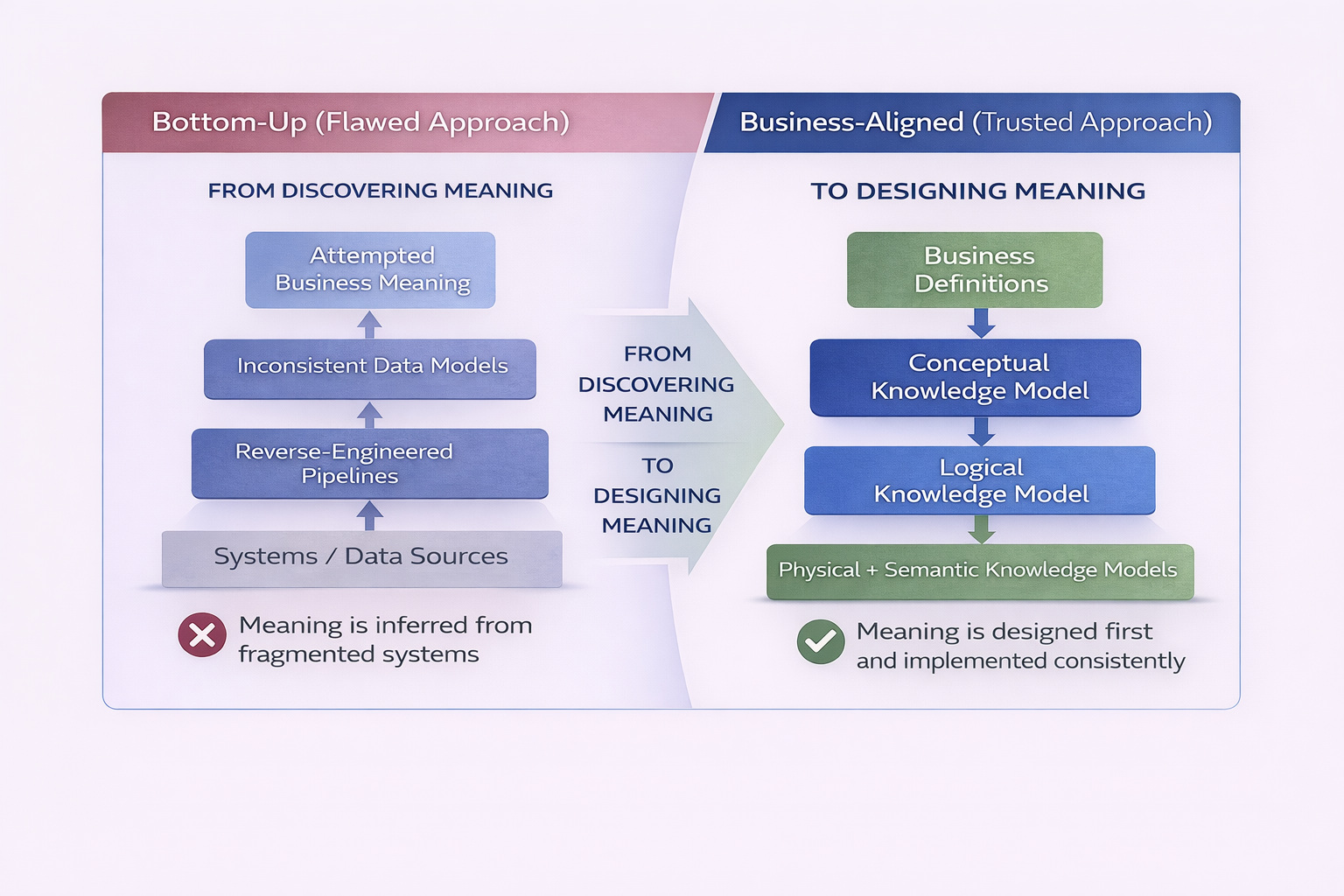
The Enterprise KnowledgePrints™ Framework
A structured method for designing enterprise knowledge before implementation begins.
Defines how business meaning is established and governed
Separates enterprise knowledge from technology implementation
Produces a reusable enterprise blueprint (Enterprise Knowledge Model™)
This framework ensures that enterprise knowledge is intentionally designed — not fragmented across systems.
Why Enterprise Knowledge Architecture™ Matters
You Wouldn’t Build a Skyscraper Without Blueprints
Enterprises invest millions in Medallion platforms, ERP transformations, and AI ecosystems.
Yet many begin implementation without a structural blueprint of enterprise meaning.
Technology continues to advance, but without architectural blueprints, enterprise meaning fragments across systems.
The Leadership Advantage of Architectural Thinking
When enterprise meaning is architected first:
Acquisitions integrate with apples-to-apples alignment
Divestitures separate cleanly
Vendor platforms align to enterprise definitions — not the reverse
Impact analysis becomes architectural, not reactive
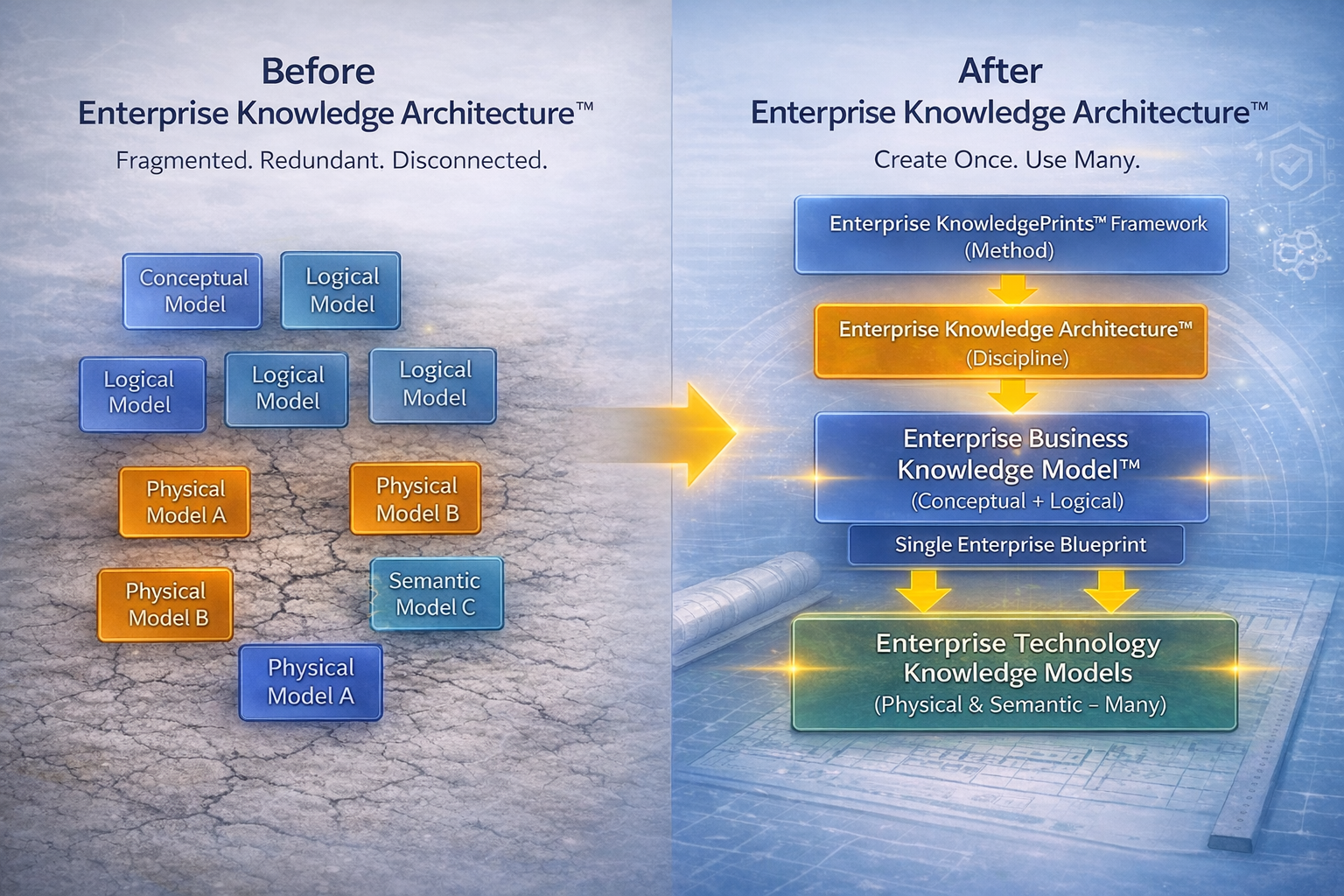
Organizations are no longer reacting to complexity.
They are designing enterprise knowledge intentionally.
Enterprise KnowledgePrints™ Framework defines the method.
Enterprise Knowledge Architecture™ is the discipline of applying that method.
The Enterprise Knowledge Model™ is the blueprint produced by that discipline — enabling consistent implementation across data platforms, analytics systems, and AI environments.
The Enterprise Knowledge Model™
The Structural Blueprint of Enterprise Knowledge
The Enterprise Knowledge Model™ is the structured enterprise blueprint produced through Enterprise Knowledge Architecture™.
It is composed of two distinct but connected layers:
Enterprise Business Knowledge Model™ (Create Once)
• One Enterprise Conceptual Knowledge Model
• One Enterprise Logical Knowledge Model
These models define business meaning, identity, and governed relationships — forming the enterprise blueprint.
Enterprise Technology Knowledge Models (Use Many)
• Many Physical Knowledge Models
• Many Semantic Knowledge Models
These models are derived from the Logical Knowledge Model and implemented across platforms, technologies, and AI environments.
This structure allows data platforms, analytics systems, governance frameworks, and AI knowledge graphs to operate from the same enterprise knowledge foundation.
Create Once. Use Many.
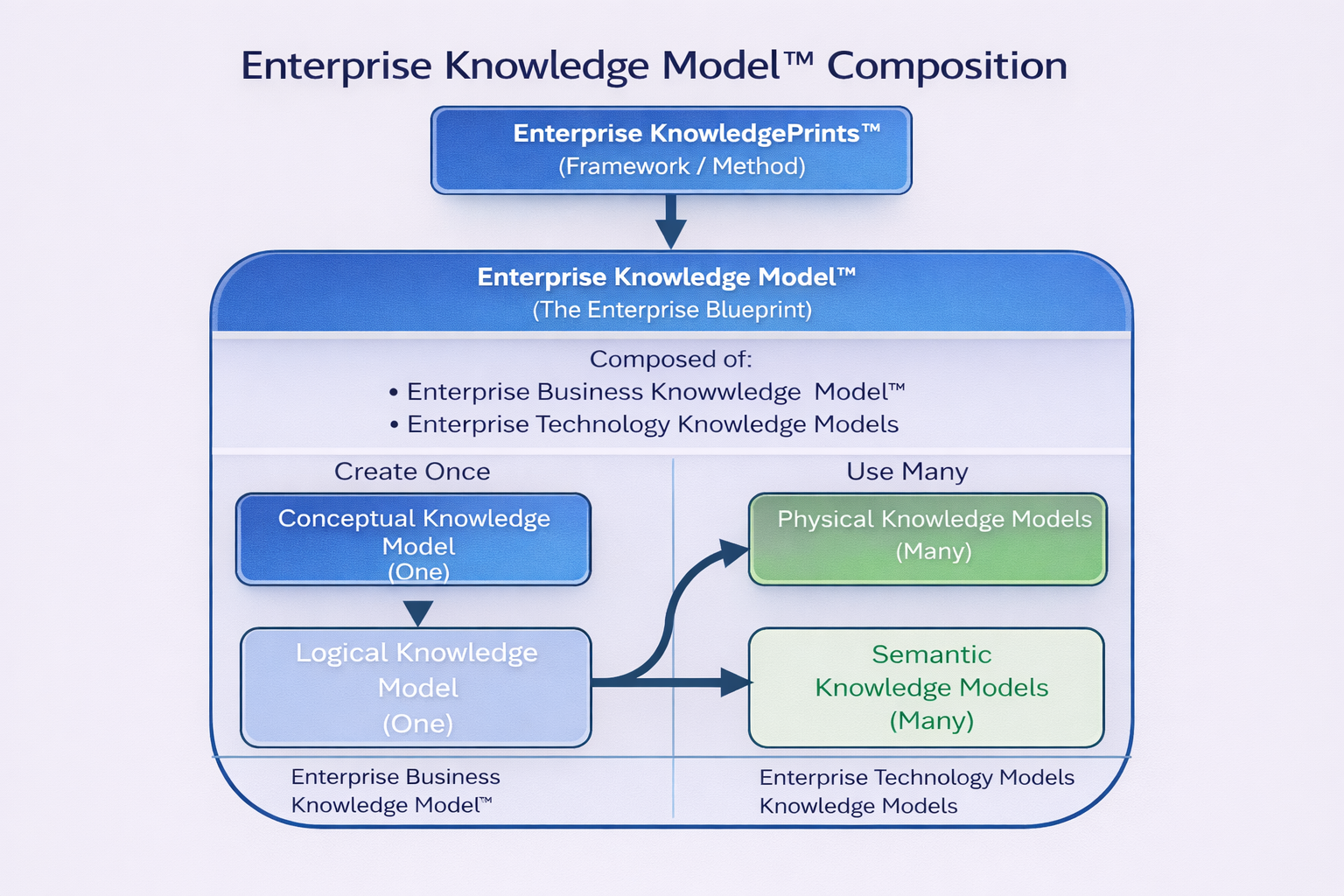
Enterprise Knowledge Architecture™ Model Stack — Create once at the conceptual and logical levels, then reuse across physical data platforms and semantic knowledge graphs.
Who This Is For
Designed for Enterprise Data & AI Leaders
Enterprise KnowledgePrints™ provides a structured method for designing durable enterprise knowledge foundations before building large-scale data platforms, governance systems, and AI ecosystems.
The methodology equips enterprise leaders to design shared conceptual and logical knowledge models that support governance, Medallion architectures, analytic platforms, and AI-ready knowledge systems.


Chief Data Officers
Establish enterprise semantic foundations that support governance, platform scalability, and cross-system data alignment.
Data Platform Teams
Accelerate Medallion architectures and analytics platforms using governed Enterprise Knowledge Models™.
Data Architecture Leaders
Design durable Conceptual and Logical Knowledge Models™ that unify enterprise meaning across systems.
AI & Knowledge Teams
Create semantic foundations that enable enterprise knowledge graphs and AI-ready data ecosystems.

Adopting Enterprise Knowledge Architecture™
Enterprise Knowledge Architecture™ is adopted through structured training programs and industry-aligned knowledge model accelerators.
Organizations may build internal modeling capabilities through formal training, or accelerate architecture maturity using reusable industry knowledge models.
Choose the path that fits your organization: