
Modern Data Modeling with Enterprise KnowledgePrints™: From Business Meaning to AI-Ready
Design Enterprise Knowledge Before You Build Data
This program teaches professionals how to design Enterprise Knowledge Models™ — durable structural blueprints that unify governance, Medallion architectures, analytics platforms, and AI ecosystems.
Participants learn how to translate business meaning into Conceptual and Logical Knowledge Models that remain stable across systems, technologies, and implementation cycles.
Participants design enterprise knowledge across the full Enterprise Knowledge Architecture™ stack:
Conceptual Knowledge Models aligned to core business meaning and enterprise vocabulary
Logical Knowledge Models that enforce business identity, normalization, durable, and technology-platform agnostic
Physical Knowledge Models engineered for Medallion architecture and modern data platforms
Semantic foundations that support modeling for knowledge graphs, and AI initiatives
The Logical Knowledge Model serves as the bridge—driving both physical implementations and semantic knowledge models.
The program teaches the full Enterprise Knowledge Architecture™ progression — from Conceptual Knowledge Models to Logical Knowledge Models that drive both relational implementations and semantic knowledge graph environments.
Professional Tool Environment
Labs use Idera ER/Studio Data Architect to demonstrate how enterprise knowledge models are created and extended in a professional modeling environment.
This program emphasizes modeling discipline and architecture, not tool-specific training.
Product-specific ER/Studio instruction is available separately through Idera.
Enterprise Knowledge Models™
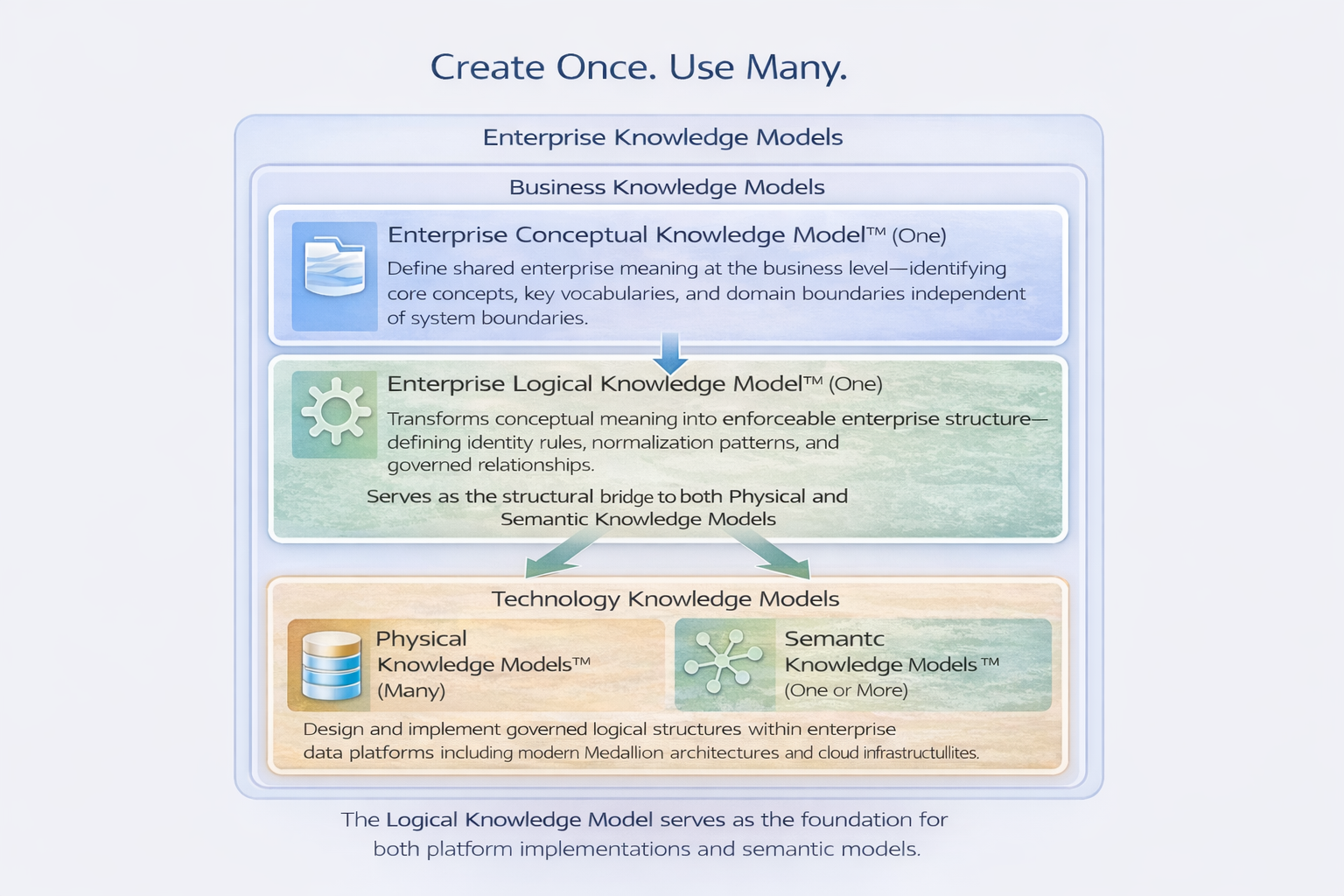
Built on Enterprise KnowledgePrints™ Enterprise Knowledge Architecture™ Framework
Most organizations generate data.
Few design enterprise knowledge.
This program teaches participants how to design Enterprise Knowledge Models™ — durable enterprise blueprints across the organization that unify governance, Medallion architectures, analytics, and AI beyond individual projects.
Participants don’t just learn modeling techniques.
They learn how to design enterprise knowledge as a reusable architectural asset.
Enterprise Knowledge Modeling™ Coverage
Participants work through the full Enterprise Knowledge Modeling™ discipline, including:
Conceptual Knowledge Modeling focused on business meaning and enterprise vocabulary
Logical Knowledge Modeling with enforceable business identity, normalization, and structural integrity
Normalization and enterprise truth design for durable Silver-layer architecture
Advanced modeling patterns, including supertypes, generalization, recursive relationships, and associative entities
Semantic modeling foundations, including how logical models translate into ontology and taxonomy design.
Knowledge graph readiness and alignment with AI / LLM reasoning environments including an overview of ER/Studio export and import feature to migrate into ontology tools.
Clear architectural separation between enterprise data modeling and data engineering implementation
This progression reflects the core principle:
Create once (Conceptual + Logical). Use many (Physical + Semantic).
What Participants Learn to Do
Participants develop the capability to:
Model business meaning independent of systems and databases
Build conceptual models aligned to enterprise vocabulary and stakeholder understanding
Define logical models that enforce identity, structure, and business rules
Normalize data to establish enterprise truth (Silver-layer foundation)
Extend logical models into semantic models (ontology & taxonomy) for AI-ready design
Design environments where structured and semantic models coexist
Use data modeling to support analytics, AI, and LLMs — without being replaced by them
How This Program Is Different
This program is not a tool-focused or database-design course.
It teaches Enterprise Knowledge Modeling™ as a strategic architectural discipline that remains stable across platforms, technologies, and AI evolution.
Participants work through realistic, industry-based labs that mirror the complexity of real enterprise environments — learning how to design durable structural knowledge assets rather than project-specific data models.
The Outcome
Participants leave equipped to design Enterprise Knowledge Models™ — reusable enterprise blueprints that endure across projects, platforms, and AI initiatives.
Immediate Capability
Establish a shared enterprise knowledge modeling language across business, architecture, and engineering teams
Design reusable Enterprise Knowledge Models that capture business meaning once and serve as the foundation for both relational and semantic implementations
Apply normalization to produce durable Silver-layer logical and physical structures
Define enforceable business identity and semantics integrity
Resolve advanced enterprise modeling patterns (supertypes, recursive, many-to-many) with architectural confidence
Strategic Alignment & Longevity
Understand how to translate Enterprise Knowledge Models into ontology-ready semantic representations
Align enterprise taxonomy and business vocabulary with structured data design
Structure knowledge models for AI / LLM reasoning readiness
Support Medallion architecture delivery while avoiding short-term design decisions that sacrifice AI semantic clarity
Bridge relational implementations and knowledge graph initiatives without rework
This program enables organizations to “create once, use many” — establishing an Enterprise Knowledge Foundation that endures as platforms, technologies, and AI capabilities evolve.
This approach reduces rework, accelerates delivery, and ensures consistent business meaning across all implementations.
Audience Profile
Professionals accountable for enterprise data design — not just implementation.
Who This Program Is For
Designed For
Data architects and senior data modelers responsible for enterprise design standards
Senior data engineers influencing structural data decisions
Analytics and data platform leads aligning modeling with Medallion architectures
AI and semantic architecture leaders bridging structured and knowledge-based systems
Governance leaders and data product owners establishing durable enterprise standards
Enterprise teams seeking a reusable modeling foundation that supports both analytics and AI
Not Designed For
Entry-level practitioners seeking introductory database training
Tool-focused implementers looking for product-specific instruction
Teams seeking product-specific or vendor-focused technical tutorials
Pipeline-only engineering roles without design accountability
This program focuses on modeling discipline, architectural thinking, and enterprise knowledge design — not software mechanics.
Delivery Format & Duration
Modern Data Modeling with Enterprise KnowledgePrints™: From Business Meaning to AI-Ready Data is delivered as a live, instructor-led experience designed for real enterprise application — emphasizing architectural design over passive learning.
The program is offered in two formats to support both enterprise teams and open cohort participants.
Instructor-Led | On-Site
Program Duration
Three consecutive days
Approximately 6 hours per day
Each session combines:
Structured instruction
Applied modeling workshops
Architectural discussion and enterprise context
Instructor-Led | Live Online
Delivered virtually in real time with direct instructor engagement.
Participants:
Engage in guided modeling exercises and applied case scenarios
Work through conceptual and logical design patterns
Receive live feedback and discussion throughout the program
Designed to replicate the rigor and interaction of in-person instruction.
Organizations that adopt this approach don’t just build better data platforms —
they design a foundation for enterprise knowledge that scales with AI.
Delivered at your organization for dedicated team engagements.
Designed to:
Align business and technical stakeholders around a shared modeling language
Establish a consistent enterprise knowledge blueprint
Apply modeling patterns directly to your domain and data landscape
Ideal for organizations formalizing data foundations to support governance, analytics, and AI initiatives.